Most founders treat the headline as the place for a slogan. Something short, smart and on brand. The actual offer gets pushed down to paragraph three, where few people ever read it. That is backwards. The headline is the first thing a buyer reads, and often the only thing. It is your offer. Below are the rules we use, and two live sites we built that show them at work.
A headline has one job
The headline’s job is to tell the right person they are in the right place. That is all. It does not need to be clever. It does not need to explain your mission or your founding story.
A buyer arrives with a problem. They scan for one signal: does this company solve my problem for someone like me? If the headline says yes, they keep reading. If it answers with a riddle, they go back to Google and click the next result.
Slogans versus offers
A slogan is about you. An offer is about the buyer. Here is a generic example, not taken from any client.
Slogan: “Building tomorrow, today.”
Offer: “Project management software for commercial builders.”
The slogan fits a bank, a robotics startup or a builder. The offer fits one kind of company and tells that company exactly what is on the table. You can still add voice and rhythm. Just keep the category and the customer in plain view.
A quick check: cover your logo and read your headline. If it could belong to a competitor, or to a company in a different industry, it is a slogan.
Evolve Construction: the category and the customer in six words
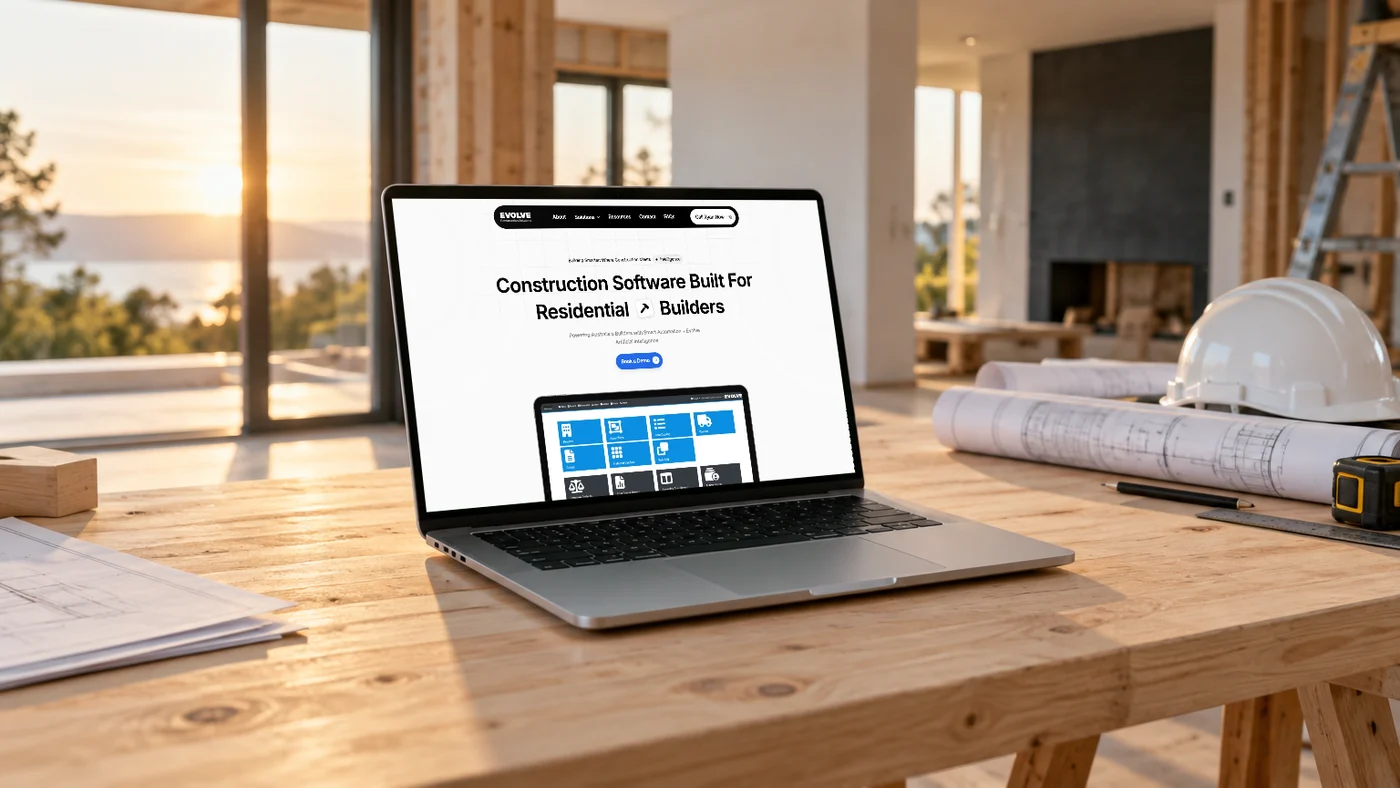
Evolve Construction, a site we built in Webflow, sells construction software for home builders. Its hero headline reads “Construction Software Built For Residential Builders.”
Six words. The first two name the category. The last two name the customer. A residential builder knows in a second that this page is for them. A company that does not build homes knows just as fast that it is not, and that is useful too.
The line under the headline speaks to Australia’s builders and promises smart automation with AI. The button says “Book a Demo”. Software that runs a builder’s operation is something people want to see before they commit, so a demo is the natural next step.
The page title in search results tells the same story: construction software for home builders. The headline, the line under it, the button and the search result all point the same way.
Diamond Air & Energy: the line above the headline does the work
Diamond Air & Energy, a site we built in Webflow, sells air conditioning, electrical and solar work in Brisbane. Its hero headline is “Perfect Air. Reliable Energy.”
On its own, that reads as a promise. What turns it into an offer is the small line sitting right above it: “Brisbane Air Conditioning and Electrical Services.” That eyebrow carries the service and the city. The big line carries the result a homeowner wants. Read together, the offer lands in one glance.
The paragraph under the headline talks to homeowners directly, about cooling and electrical work built for long-term reliability. The hero button says “Contact Our Team”, and the header keeps a phone number and a “Get a Quote” button in view. For a local trade, that is the right set of actions. Someone who needs an electrician wants to call or get a price, not read a brochure.
The page title adds solar and names Brisbane again. A buyer searching for local air conditioning, electrical or solar work sees the service and the area before they even click.
The lesson: if you want a short, punchy headline, pair it with a plain line that names what you sell and where. Remove that line and the offer goes with it.
What sits around the headline
The headline does not work alone. Buyers read the top of the page as one block, and each piece has a job.
- The eyebrow names the category or the area when the headline leads with a result.
- The headline names the offer, or the result the offer delivers.
- The subheadline adds who it is for and why it is worth their time.
- The button asks for the next step that fits the buyer: a demo, a quote or a call.
- The page title repeats the offer for people who meet you in search first.
If one of these says something different from the others, the buyer has to work out which one to believe. Most will not bother.
The same structure holds whether you sell software, a trade service or advice. When your offer fits in one line, your headline has something clear to say.
How we write the headline before the design
- Write the offer as one plain sentence. What you sell, who it is for, what they get.
- Pull the headline from that sentence. Lead with the part your buyer cares about most.
- Move what did not fit. It goes into the eyebrow or the subheadline, not into a longer headline.
- Pick the button last. Choose it from how your buyer prefers to take the next step.
- Then design. Type, layout and motion come after the words are settled.
The order matters. A layout built around a vague headline has to be reworked once the headline gets fixed. A layout built around a clear offer only gets stronger with every design decision.
Start with the offer
We have completed 400+ jobs and earned 230+ five-star reviews building Webflow and Framer sites for startups and established businesses. Our principle is simple: say what you sell in one sentence, and get the headline and the offer right before anything gets styled.
If your headline reads more like a slogan than an offer, book a call.